The Best Siding Materials for Fighting San Francisco Coastal Rot
San Francisco’s coastal strip does things to siding that inland neighborhoods never see. Karl the Fog brings 150-plus fog days per year to the Outer Sunset, Outer Richmond, and Sea Cliff. That fog carries salt. Salt attacks fasteners and sealants. Wind-driven rain soaks west-facing walls at Ocean Beach and Baker Beach. Homes in 94122, 94116, 94121, and Sea Cliff often show visible wood rot on west elevations 8 to 12 years after installation if the wall system lacks a proper moisture barrier and stainless fasteners. Property owners who search for siding contractors Bay Area want materials and installation discipline that stand up to that environment. This page explains what works on the coast, what fails, and how Best Exteriors specifies and installs systems that keep water out while preserving the character of San Francisco homes.
Why coastal rot is worse on the west side of San Francisco
Moisture drives rot. The Pacific marine layer pushes salt-laden fog across the Sunset and Richmond most mornings and evenings. Salt accelerates corrosion on nails and screws, which opens small leaks at every penetration. Those leaks let water reach the sheathing. Once moisture reaches wood-based sheathing like OSB, fungal decay starts. Paint bubbles. Siding cups or warps. Caulk joints split. On the Marina and Embarcadero waterfronts, tides add airborne salt, and winds funnel along the Bay. In the Mission, Noe Valley, Bernal Heights, and the Castro, Twin Peaks casts a fog shadow, so sun and UV are the bigger enemies. That contrast matters when selecting materials and fasteners. It also shapes the field practices that siding contractors Bay Area must follow if the system is going to last.
The materials that beat coastal rot
Four cladding families get used most across San Francisco and coastal Marin. Each behaves differently under fog, salt, and wind. Best Exteriors installs all four, but the material choice depends on exposure, architecture, and code. The Outer Sunset and Outer Richmond often benefit from fiber cement for noncombustibility, dimensional stability, and low water absorption. Pacific Heights Victorians may need cedar or redwood to preserve historic profiles. The Marina District brings direct waterfront exposure that drives stainless and marine-grade sealants. Sacramento and inland Contra Costa bring heat cycles that change the calculus again. The right answer starts with the home’s street, not a catalog.
Fiber cement: James Hardie HardiePlank, HardieShingle, and HardiePanel
Fiber cement is a cement and cellulose composite that does not burn, does not warp in heat, and does not rot when installed with a functioning drainage plane. James Hardie is the dominant brand. Their HardieZone 4 coastal system specification covers San Francisco, coastal Marin, and coastal San Mateo. It defines how to wrap, flash, fasten, and seal so the wall dries after rain. The product is Class 1A fire rated with ASTM E84 Class A flame spread and noncombustible classification under ASTM E136. It meets ASTM C1186 and C1325. HardiePlank lap siding comes in Cedarmill and Smooth. HardieShingle panels recreate the shingle look with straight or staggered edges. HardiePanel vertical siding suits Eichler and mid-century lines found in Diamond Heights and Miraloma Park. ColorPlus Technology gives a factory-applied finish with a 15-year fade warranty. James Hardie provides a 30-year product warranty when the installer follows the manual. The coastal rot advantage is clear. Fiber cement does not absorb water like wood and does not soften like vinyl under sun and heat cycles. It holds paint longer, especially with ColorPlus.
Grade-A cedar and redwood for historic homes
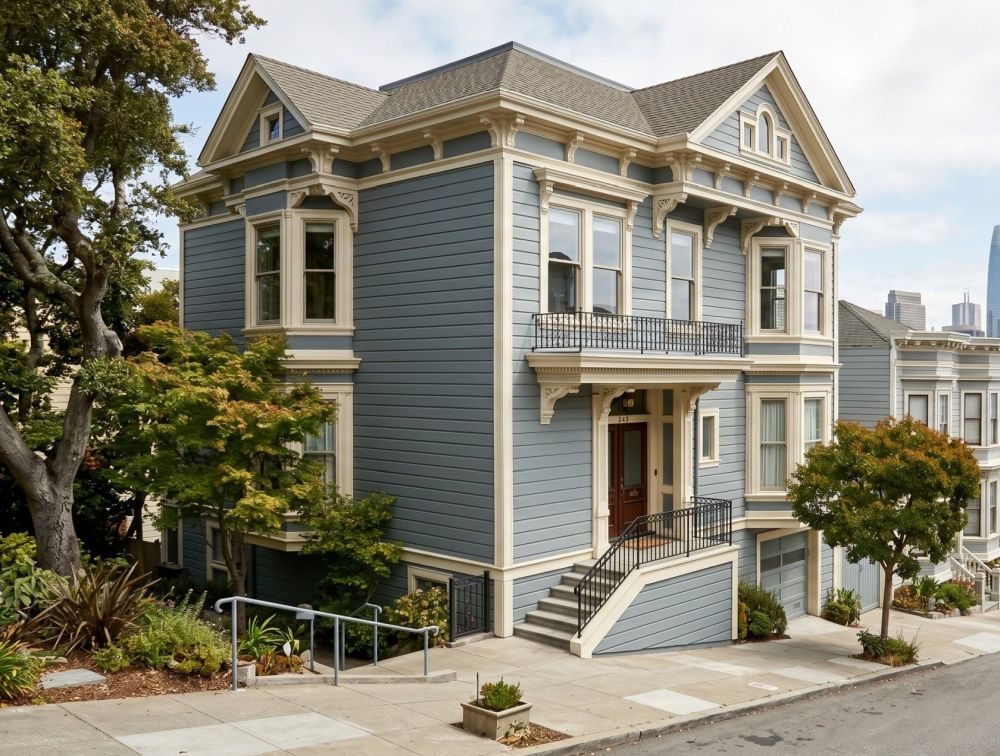
Victorian and Edwardian streets from Alamo Square through Liberty Hill to Dolores Heights and Pacific Heights often require profile-accurate restoration. Many of these houses still hold original redwood or cedar, but the west and south faces show deep decay. Replacement can match the original with Grade-A Western Red Cedar shingles or milled redwood lap boards. For Queen Anne gables, HardieShingle can serve as an accent where jurisdiction allows, combined with wood trim to preserve shadow lines. In historic districts, the SF Planning Department applies the Preservation Design Standards that took effect April 1, 2025. That review focuses on appearance, not necessarily material. Many projects pass with HardiePlank Cedarmill at a 4.5-inch exposure to mimic the original reveal, while trim remains wood or AZEK to match decorative detail. Wood offers unmatched authenticity, but the coastal rot risk is higher without strict moisture management, stainless fasteners, and a ventilated drainage plane. Maintenance cycles tighten to 5 to 7 years for repainting on fogfront blocks.
Vinyl and insulated vinyl
Vinyl siding, including insulated lines like Prodigy, attracts owners looking for lower upfront cost and a light-weight install. In the fog belt, vinyl faces two challenges. Thermal expansion and contraction can open joints if not installed with the right gap and nailing tension. Wind-driven rain in the Sunset can pressure water through joints because vinyl is not a sealed barrier. The drainage plane must carry the whole waterproofing load. In Sacramento or Walnut Creek, heat cycles stretch vinyl more than in San Francisco. Experienced siding contractors Bay Area calibrate expansion for 100 to 105 degree summer highs in the Sacramento Valley while still securing panels against gusts. Vinyl can work inland with a strict focus on the underlayment and accessory detailing. On the immediate coast and in WUI fire zones, fiber cement often wins.
Engineered wood and other options
LP SmartSide and similar engineered wood products bring a wood look with a factory coating. They need vigilant flashing and sealant details, especially at butt joints and penetrations. In wildfire-prone East Bay Hills, Chapter 7A of the California Building Code pushes owners toward noncombustible cladding. That rules out vinyl and standard wood. Metal siding appears on some contemporary homes in SoMa and Dogpatch, but historic blocks rarely allow it. For most coastal rot scenarios where noncombustibility matters, HardiePlank remains the practical, code-friendly choice.
Fasteners, sealants, and accessory choices that make or break coastal projects
A strong cladding fails fast if the crews choose the wrong nails or caulk. The fog belt requires stainless steel ring-shank nails for fiber cement and cedar. Hot-dip galvanized nails can stain and corrode near Ocean Beach and Lands End. On the waterfront in 94123, 94107, and 94105, stainless is the standard. The sun belt across 94110, 94114, and 94131 can accept hot-dip galvanized fasteners as long as they meet manufacturer specs. Caulk choice matters too. Marine-grade polyurethane caulk resists salt and stays flexible longer at window perimeters and at butt joints where caulk is approved. Standard polyurethane can work inland, but not at Sea Cliff or Crissy Field exposures. Best Exteriors trains crews to flush-drive fasteners without face fracture and to hold the nail head shy of crushing the board. Over-driven nails crack fiber cement and invite leaks. These are small choices that separate durable work from callbacks.
Weather barrier and flashing: the actual water management system
The cladding is not the waterproofing layer. The weather resistant barrier, often HardieWrap or Tyvek, is the line of defense. It must shingle lap from bottom to top so water flows out, not in. Z-flashing belongs at every butt joint for fiber cement lap siding. Kickout flashing diverts roof runoff away from walls at roof-to-wall intersections. Drip caps sit above window heads. Sill pans send water back out at window bases. Each of these parts fails often in San Francisco’s older stock because earlier remodels skipped steps. When crews discover peeling or bubbling siding, dry rot often has already reached the OSB sheathing. That turns a $25,000 siding replacement into a $33,000 or higher combined siding and sheathing scope. Correct sequencing is not optional in the fog belt. It is the difference between a wall that dries after every storm and a wall that stays wet until fungi eat it from the inside.
Why HardieZone 4 matters on the coast
James Hardie tests regional exposures and issues system specifications. HardieZone 4 covers coastal Northern California. It dictates stainless fasteners at marine exposures, WRB selection, clearance to grade, clearance to roofing, and joint flashing patterns. The spec also calls for field-priming cut edges and avoiding face nailing except where required. These details drive the James Hardie 30-year product warranty and the ColorPlus 15-year fade warranty. Projects installed by a James Hardie Elite Preferred Contractor qualify for manufacturer-backed coverage that uncertified installers cannot secure. In practice, that warranty leverage drives better workmanship because approved contractors follow the manual on every elevation. Owners who compare siding contractors Bay Area should ask for HardieZone 4 details in writing. The right answers sound like WRB sequencing, Z-flashing at butt joints, kickout flashing, and stainless on coastal faces, not just “we use Hardie.”
Shareable reality: fast PermitSF approvals for in-kind fiber cement replacements
San Francisco fully moved to the PermitSF online portal on February 13, 2026. In-kind siding replacements that swap failing wood lap for fiber cement lap of the same exposure now run through the digital pathway. When submittals include elevations, scope description, fire classification documentation, and a clear site plan, approval can land in two business days in residential zip codes like 94122, 94116, 94118, and 94114. That speed is night-and-day compared to the old lines at 49 South Van Ness Avenue. Historic district projects still route through Planning. Those typically take 3 to 8 weeks depending on review. Seasoned siding contractors Bay Area plan materials and scaffolding around the approval window to keep jobs moving.
Neighborhood-by-neighborhood specification examples
Outer Sunset and Outer Richmond demand stainless nails, marine-grade polyurethane caulk, HardieZone 4 sequencing, and extra attention at roof-to-wall kickouts where blown sand and rain meet. Homes near Lake Merced see persistent damp and need wider clearances to grade and paving so splashback does not wet the bottom courses. Sea Cliff homes face direct ocean exposure plus wind. Stainless is non-negotiable. ColorPlus darker tones can fade faster on south faces that get midday sun breaks. In the Marina and along the Embarcadero, wind-driven rain demands crisp window flashing with taped WRB and stainless head flashings. The Mission, Noe Valley, Glen Park, and Bernal Heights sit in a fog shadow. Sun matters more than salt. Hot-dip galvanized nails are acceptable, and fade resistance becomes a bigger factor on south and west faces. In Oakland, Alameda, and Berkeley, the Bay Bridge corridor carries salt inland, but corrosion rates drop a notch. Hot-dip galvanized fasteners work on most properties, with stainless upgrades within a mile of the waterline in Alameda 94501 or the Berkeley Marina.
WUI fire zone controls the material in the East Bay Hills
Oakland Hills, Berkeley Hills, Orinda, Lafayette, and Moraga sit inside CalFire-designated Wildland-Urban Interface zones. Chapter 7A requires noncombustible cladding. Fiber cement satisfies the rule with its Class 1A fire rating. Vinyl and cedar do not. Owners in 94605, 94611, 94708, 94563, 94549, and 94556 should plan on fiber cement or metal. Many hillside craftsman homes use HardieShingle panels to recreate a cedar look while meeting code. Siding contractors Bay Area who work in the hills also address ember-resistant attic vents and soffit details, since siding performance is only part of the exterior assembly in a fire zone.
What failure looks like on coastal walls
Rot does not start where it is easy to see. It usually begins behind trim and at penetrations. Owners in the Outer Sunset often report paint blistering near window sills, or staining below fastener heads. Those are late-stage symptoms. By then, moisture has often reached the sheathing. Probing around bay window trim in Russian Hill or the Marina can show soft wood hidden behind intact paint. Roof-to-wall joints without kickouts send water behind siding at stucco or shingle transitions. These patterns repeat in field inspections from Ocean Beach to Crissy Field. Early diagnosis matters. Siding contractors Bay Area who specialize in building envelope work will open small test areas to confirm sheathing condition before issuing a final scope. That prevents surprises during tear-off.
Material profiles that match San Francisco architecture
San Francisco’s housing stock spans Queen Anne Victorians around Alamo Square, Edwardian flats in Mission Dolores and Inner Richmond, Marina-style buildings along 94123, and mid-century Eichler-influenced homes in Diamond Heights. HardiePlank Cedarmill at a 4.5-inch exposure matches many original redwood reveals on Victorians and Edwardians. HardieShingle straight edge panels recreate gable accents common in Haight-Ashbury. HardiePanel vertical siding respects Eichler post-and-beam lines. AZEK or wood trim preserves cornices, belt courses, and window hoods. On Painted Ladies, ColorPlus neutral palettes like Cobblestone or Monterey Taupe hold up to sun breaks while reading period-correct. In Noe Valley and Bernal Heights, contemporary remodels often use Smooth lap or vertical panels for clean lines without losing the neighborhood feel.
Windows and siding perform as one system
Many coastal siding projects pair with window replacement because the water path often starts at window perimeters. Certified dealers who install Anlin Windows integrate flanged frames with the same WRB and flashing sequence. Anlin’s QuadraTherm dual pane insulation system with Infinit-e Low-E glazing hits Title 24 U-factor and SHGC targets while keeping salt air out of balance cavities. That helps on fog belt walls that stay cool and damp. On the Marina and Sea Cliff waterfronts, stainless head flashings and rigid sill pans matter as much as glass specs. In premium view corridors near Coit Tower or along the Embarcadero, maintaining sightlines drives frame selection. Siding contractors Bay Area who also handle Certified Anlin Dealer installations reduce coordination gaps between trades and keep the weatherproofing continuous.
Cut quality, joint control, and drainage plane verification
Fiber siding contractors Bay Area cement needs carbide-tipped blades for clean cuts. Cut edges get field-primed. Butt joints should land on studs or on approved joint flashing with a consistent gap. Fastener spacing follows the Hardie manual. Starter strips set the first course dead level. Each reveal must match to the sixteenth across long walls so water sheds in straight paths. At the end of each day, crews inspect the drainage plane to ensure no reverse laps exist and that tape at window flanges seals to the right side of the shingle lap. This discipline sounds fussy because it is. It is also the reason Hardie walls in the Outer Richmond keep performing while others fail early. Owners comparing siding contractors Bay Area should ask to see photos of the WRB and flashing layers before cladding goes on. Trust the contractor who shows that work without being prompted.
Cost reality for 2026 and what shifts the range
Installed pricing in the Bay Area ranges from about $7 to $20 per square foot depending on material, complexity, and access. A typical San Francisco full replacement sits between $25,000 and $55,000, with Victorians on steep lots at the upper end because of detailing and scaffolding. San Francisco carries a 25 to 40 percent labor premium over standard East Bay or Sacramento tract homes. Dry rot remediation and OSB sheathing replacement often add $3,000 to $8,000 depending on spread. Asbestos cement siding removal, common in pre-1981 housing across San Francisco and Alameda, runs about $7 to $12 per square foot on top of replacement. Fiber cement continues to deliver strong resale returns, often in the 80 to 95 percent range, because buyers value low maintenance and fire resistance. The right contractor will document findings with photos during tear-off so owners see where dollars go. Siding contractors Bay Area who show that transparency keep change orders fair and limited to verified conditions.
Permitting and code checkpoints owners should expect
San Francisco DBI now processes siding permits through the PermitSF digital portal. In-kind replacements in residential blocks can move in two business days when packages are clean. Historic review adds time. The 2025 California Building Codes took effect January 1, 2026, and govern clearances, fire classification, and energy sealing. Title 24 energy rules tie in at penetrations and assemblies where windows or doors are replaced. East Bay jurisdictions such as Oakland, Berkeley, and Alameda run permits through their municipal portals and counters, and often accept over-the-counter in-kind replacements with proper documentation. Marin, San Mateo, and Contra Costa vary by city. Sacramento County work follows the local Community Development process. Owners hiring siding contractors Bay Area should confirm who handles permit submissions, inspection scheduling, and final sign-off. Experienced firms manage that paperwork, including DBI inspections and SF Planning coordination when projects sit in Alamo Square, Liberty Hill, or Dolores Heights historic districts.
Sacrament o and inland Contra Costa require different calibration
In Land Park 95818, East Sacramento, and Folsom 95630, heat cycling reaches 100 to 105 degrees in summer with low humidity. Fiber cement tolerates these swings without distortion. Vinyl must be installed with calibrated gaps and proper nailing tension to prevent buckling. ColorPlus fade resistance matters on west and south faces that soak heat. Hot-dip galvanized fasteners are adequate in these inland locations. Wind-driven rain is not the primary problem inland, so marine-grade caulk is not mandatory. Owners comparing siding contractors Bay Area who service both coasts and valley should hear different specifications when the home sits in Sacramento versus the Outer Sunset.
Where homeowners see the first signs of trouble
Owners often report small clues long before full failure. Watch for these red flags along the coast and waterfront:
- Paint blisters or peeling on west-facing walls, especially near window sills and trim. Rust streaks or stains below nail heads on lap siding courses. Gaps or split caulk lines at butt joints and vertical trim intersections. Soft wood when a screwdriver probes near roof-to-wall transitions without kickout flashing. Musty odor inside walls after storms, often near the Marina or along Crissy Field.
These symptoms often signal that water has already reached the sheathing. At that point, a full tear-off with OSB or plywood sheathing replacement on affected bays protects the framing and insulation. Siding contractors Bay Area with envelope experience will specify moisture barrier sequencing, flashing corrections, and the right fastener and sealant set for the microclimate.
What a durable coastal wall assembly looks like
The assembly is a system. It starts with sound framing. Then sheathing. Then a continuous weather resistant barrier, properly lapped. Window flanges integrate with the WRB using head flashings and sill pans. Penetrations for vents and lights get gaskets or flashing boots. Starter strips and true courses for lap or panel siding come next. Z-flashing rides over every butt joint. Stainless steel ring-shank nails fasten courses to framing. Gaps at butt joints match manufacturer specs and never butt tight. Field cuts get primed. Caulk beads run continuous where allowed, with marine-grade polyurethane on the coast. The wall finishes with trim, drip caps, and kickout flashings. Crews photograph each layer before covering it. That record proves the system was built to the manual and to 2026 codes.
Examples from around the Bay
Outer Richmond 94121: 1920s Marina-style home with failing redwood lap on the west elevation. The specification used HardiePlank Cedarmill at 4.5-inch exposure, HardieWrap, stainless fasteners, and marine-grade caulk. Kickout flashing corrected at the north roof-to-wall. PermitSF in-kind approval posted in 48 hours. OSB replacement limited to two bays thanks to early intervention.
Sea Cliff: Ocean-facing remodel required full stainless throughout, deeper starter strip clearance to prevent splashback, and ColorPlus mid-tone to limit UV fade on south faces. HardieShingle accents kept the original character in the gables, with AZEK trim for cornices where original wood had decayed.
Oakland Hills 94605: WUI-compliant HardieShingle system replaced cedar shingles. Class 1A fire rating satisfied Chapter 7A. Flashing and soffit vents upgraded to ember-resistant assemblies. Hot-dip galvanized fasteners acceptable on east and north faces; stainless at windward west exposure near the ridge.
Marina 94123: Wind-driven rain from the Bay required taped WRB with rigid head flashings over new Anlin windows installed by a Certified Anlin Dealer. Integration to the siding prevented the historic bay window trim from taking water during winter storms. Views to the Golden Gate Bridge remained untouched by careful frame selection.
Why installer credentials and inspection discipline affect rot risk
Manufacturer credentials are not marketing fluff. James Hardie Elite Preferred Contractors pass audits on installation practice and project volume. That standard leads to consistent WRB sequencing, joint flashing, and fastener depth that keep water out. Certified Anlin Dealers integrate window and siding details to a single set of drawings so there are no gaps at perimeters. NARI membership, BBB Accredited A+ performance, and Diamond Certified ratings are signals that a firm operates with documented processes. In the fog belt, those processes are the difference between a wall that drains and a wall that traps water. Owners comparing siding contractors Bay Area should look for photo documentation of the WRB and flashing before cladding, not just glossy after shots.
How to think about material choice by exposure
Owners often want a simple answer. The right choice depends on moisture, salt, sun, fire code, historic requirements, and budget. The following rule-of-thumb holds across hundreds of Bay Area projects:
- Immediate coast and waterfront: fiber cement with stainless fasteners and marine-grade polyurethane caulk. Fog shadow sun belt neighborhoods: fiber cement or engineered wood with fade-resistant finishes and hot-dip galvanized fasteners. Historic districts: profile-matched HardiePlank Cedarmill or Grade-A cedar, with Planning coordination under the Preservation Design Standards. WUI fire zones: fiber cement or metal only, Class 1A fire rating compliance required. Sacramento Valley: fiber cement for thermal stability, or vinyl with careful expansion calibration and a robust drainage plane.
What “good” looks like during and after install
A good installation stays quiet in the storm. Inside, no musty smells. Outside, no streaking below nails, no cupping, no separated caulk joints. Courses run true along long Victorian facades on Hayes Street near Alamo Square. Vertical panels land plumb on mid-century lines in Miraloma Park. At Lake Merritt and Jack London Square, waterfront condos show tight joints and clean transitions at decks. Inspections document drainage plane integrity before cladding. DBI final passes without corrections because flashing is visible, clearances to grade are right, and fire classification paperwork is in the permit file. Siding contractors Bay Area who deliver that result do the small things correctly, every time.
Local coverage and logistics matter in San Francisco
Access is tough on narrow streets in Russian Hill and North Beach 94133. So is staging along Dolores Park in 94110 or near Twin Peaks. Coastal blocks in the Outer residential siding contractors Bay Area Sunset need sand protection and wind screens around scaffolding. Highway 1 and the Great Highway add logistics challenges for deliveries, especially during weekend closures. Bay Bridge traffic between 94612 and 94111 affects scheduling and inspection timing. Crews familiar with SF Parking and the DBI inspection calendar keep projects on track. Siding contractors Bay Area who do this every week bring that muscle memory to each job.
Why this topic matters for owners comparing siding contractors Bay Area
Rot is expensive, but avoidable. The cost gap between a wall that dries and a wall that traps water plays out in thousands of dollars of sheathing replacement. The knowledge gap between an installer who follows the HardieZone 4 manual and one who guesses shows up in fastener stains and failing caulk within a few winters. San Francisco’s microclimate asks more of siding than most cities. It rewards owners who select materials and installers with a track record in the fog belt, the sun belt, the waterfront, and WUI hills. That is the core of this decision.
Ready to plan a siding project built for San Francisco’s coastal rot
Property owners who need a contractor with proven Bay Area microclimate judgment can book a free in-home or virtual consultation with Best Exteriors. The company operates from 1999 Harrison Street Suite 10219, Oakland 94612, and dispatches across San Francisco County, Alameda County, Contra Costa County, Marin County, San Mateo County, Santa Clara County, and Sacramento County. Best Exteriors is a James Hardie Elite Preferred Contractor and manages PermitSF applications, DBI inspections, and SF Planning historic coordination. The team is Diamond Certified, BBB Accredited A+, CSLB Licensed and Insured (License #923505), NARI member, and EPA Lead-Safe Certified for pre-1978 housing. Certified Anlin Dealer status covers window integration when projects combine cladding and glazing. All siding installations carry a Double Lifetime Warranty with a 2026 California Building Code compliance guarantee. Financing is available at 100 percent of project cost, with $1,000 off current promotional pricing. Owners searching for siding contractors Bay Area who can diagnose rot, specify the right HardieZone 4 or historic system, and install with stainless and marine-grade detailing on the coast can call +1-510-616-3180 or request a consultation online. Projects in 94122, 94116, 94118, 94114, the Marina 94123, and the East Bay WUI hills receive full permit handling and photo-documented installation. Siding contractors Bay Area differ. Best Exteriors shows the work behind the walls and stands behind it for life.
Best Exteriors
Premium Window & Siding Specialists
The Pacific Heights Standard: We utilize Marvin Ultimate Wood Windows with a U-Factor of 0.22, exceeding 2026 Title 24 standards. Our team navigates the San Francisco Planning Department case-by-case review, securing Form 8 permit applications for historic architectural integrity.